


News
Surprising Facts About the Origins of Halloween and the Tradition of Trick-or-Treating
Aug
Every October, neighborhoods across the United States undergo a familiar, spooky transformation. Front porches are adorned with carved pumpkins glowing in the dark, front yards are transformed into makeshift graveyards with faux cobwebs, and supermarket aisles overflow with bags of bite-sized candy. Millions of children and adults prepare their costumes for a night of trick-or-treating, parties, and haunted houses. Today, Halloween is a multi-billion-dollar commercial holiday, a cornerstone of American culture that blends frights with sugary delights.
But have you ever paused while unwrapping a peanut butter cup or carving a face into a gourd to ask: Why exactly do we do this?
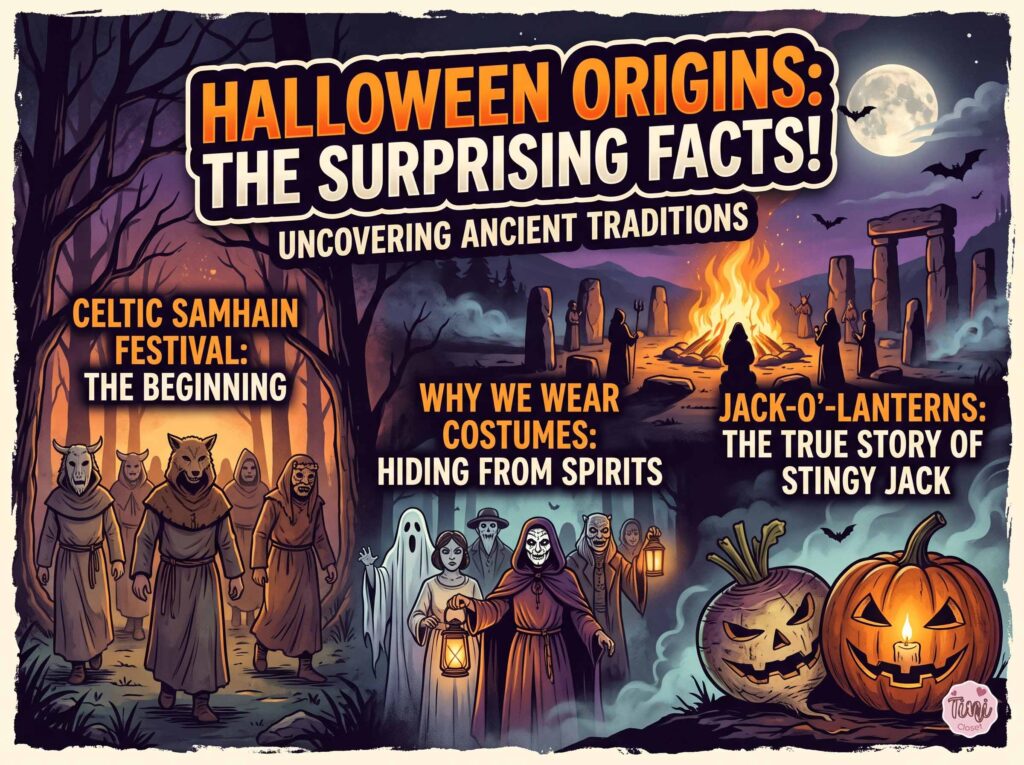
The origins of Halloween are far older, darker, and more deeply rooted in spiritual folklore than the plastic masks and candy wrappers suggest. The history of Halloween is a fascinating tapestry woven from ancient pagan rituals, medieval Christian traditions, European folklore, and early 20th-century American societal shifts.
If you are ready to peel back the modern commercial layers of October 31st, read on to discover the surprising facts about the origins of Halloween, the true meaning behind the Jack-o’-lantern, and the surprisingly chaotic history of trick-or-treating.
The Ancient Roots: The Celtic Festival of Samhain
To understand the origins of Halloween, we have to travel back over 2,000 years to the Celtic regions of Europe—primarily modern-day Ireland, the United Kingdom, and northern France. For the Celts, the year was divided into two distinct halves: the light half (summer) and the dark half (winter).
The transition between these two halves was marked by a pivotal and sacred festival called Samhain (pronounced sow-in), celebrated from sunset on October 31st to sunset on November 1st.
Samhain translates roughly to “summer’s end.” It was a crucial pastoral and agricultural milestone, marking the end of the harvest and the onset of the cold, harsh winter—a season historically associated with human death and scarcity.
The Thinning of the Veil
The Celts possessed a deeply mystical worldview. They believed that during Samhain, the cosmic barrier separating the physical world of the living from the spiritual realm of the dead became exceptionally thin. This blurred boundary allowed spirits, ghosts, and otherworldly beings—known as the Aos Sí (or fairies)—to cross over into the mortal world.
While the presence of ancestors was welcomed and honored, the Celts also feared malevolent spirits who might ruin crops, cause illness, or wreak havoc on the community.
To appease these wandering spirits and protect their people, Celtic priests, known as Druids, built massive, sacred bonfires. (The word “bonfire” actually derives from the Middle English bone-fire, as the bones of slaughtered livestock were often thrown into the flames). Communities would gather around these towering infernos to burn crops and sacrifice animals to their deities.
A Spark for the New Year: During the Samhain celebration, families would extinguish their own hearth fires at home. Once the communal Druidic bonfire had burned down, they would carry an ember from the sacred fire back to their dwellings to re-light their hearths. This ritual was believed to bring protection and warmth throughout the dark winter months.
Because the spiritual veil was so thin, the Druids also believed that Samhain was the most potent time of the year for divination and prophecy. The predictions made by priests during this night provided vital comfort and direction for a populace facing a long, unforgiving winter.
From Samhain to All Hallows’ Eve: The Christian Influence
By the year 43 AD, the Roman Empire had conquered the vast majority of Celtic territory. Over the next four centuries of Roman rule, two distinct Roman festivals were gradually combined with the traditional Celtic celebration of Samhain:
-
Feralia: A day in late October when the Romans commemorated the passing of the dead.
-
Pomona: A festival honoring the Roman goddess of fruit and trees. The symbol of Pomona is the apple, which seamlessly explains the enduring Halloween tradition of bobbing for apples.
However, the most significant shift in the history of Halloween came with the spread of Christianity. As the Catholic Church expanded its influence into Celtic lands, it often employed a strategy of syncretism—absorbing and rebranding existing pagan holidays to make Christianity more palatable to the native populations.
In the 8th century, Pope Gregory III officially expanded a localized holiday honoring all Christian martyrs to include all saints, and he moved the observance from May 13 to November 1st. This day became known as All Saints’ Day, or All Hallows’ Day (from the Middle English word Alholowmesse).
Consequently, the traditional night of Samhain on October 31st became known as All Hallows’ Eve—the night before the holy day. Over the centuries, linguistic evolution shortened and mashed “All Hallows’ Eve” into the word we use today: Halloween.
In the year 1000 AD, the church added another layer by designating November 2nd as All Souls’ Day, a day strictly dedicated to honoring and praying for the dead. The observance of All Souls’ Day bore a striking, intentional resemblance to Samhain, complete with massive bonfires, parades, and people dressing up as saints, angels, and devils.
The True Meaning Behind Carving Pumpkins (Jack-o’-Lanterns)
No symbol is more synonymous with American Halloween than the glowing, grinning face of a carved pumpkin on a front porch. But the tradition of the Jack-o’-lantern actually originated in Ireland, and it originally had absolutely nothing to do with pumpkins.
The tradition stems from a dark, centuries-old Irish folktale about a man known as Stingy Jack.
The Legend of Stingy Jack
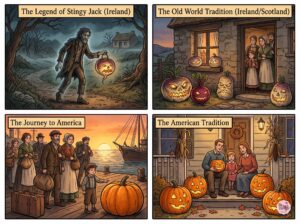
According to the legend, Stingy Jack was a miserable, manipulative drunkard who had the audacity to invite the Devil to have a drink with him. True to his name, Stingy Jack didn’t want to pay for his ale, so he convinced the Devil to turn himself into a coin that Jack could use to settle the tavern tab.
Once the Devil transformed, Jack pocketed the coin, placing it next to a silver cross. The cross stripped the Devil of his powers, trapping him in the form of a coin. Jack eventually freed the Devil, but only under the strict condition that the Devil would leave Jack alone for a year, and that if Jack died, the Devil would not claim his soul.
The following year, Jack tricked the Devil again, this time convincing him to climb a tree to pick a piece of fruit. While the Devil was high in the branches, Jack carved a cross into the tree’s bark, trapping him once more. Jack extracted another promise: the Devil could not bother him for ten more years, nor could he claim his soul.
Shortly after this second trick, Jack’s body gave out, and he died.
As the legend goes, God would not allow such an unsavory, deceptive figure into Heaven. The Devil, keeping his promise and perhaps still angry at Jack’s tricks, refused to allow Jack into Hell.
Instead, the Devil cast Jack out into the dark night of eternity, tossing him a single burning coal straight from the fires of Hell to light his way. Jack scooped out a large turnip to hold the burning coal, creating a makeshift lantern, and has been endlessly roaming the earth ever since. The Irish began referring to this ghostly, wandering figure as “Jack of the Lantern,” and eventually, simply Jack-o’-lantern.
From Turnips to Pumpkins
In Ireland and Scotland, people began making their own versions of Jack’s lantern to frighten away Stingy Jack and other wandering evil spirits. However, they did not use pumpkins. The original Jack-o’-lanterns were carved from large turnips, potatoes, and even beets. They carved terrifying, grotesque faces into the root vegetables and placed them in windows or near doors.
If you look up pictures of 19th-century turnip Jack-o’-lanterns, be warned: they are genuinely terrifying and look like shrunken, spectral heads.
When waves of Irish and Scottish immigrants arrived in the United States during the 19th and early 20th centuries, they brought the Stingy Jack tradition with them. Upon arriving in America, they discovered the native pumpkin (Cucurbita pepo). Pumpkins were abundant, softer, larger, and significantly easier to carve than a dense turnip. The tradition swiftly adapted to the local agriculture, and the pumpkin Jack-o’-lantern was born.
Why Do We Wear Costumes on Halloween?
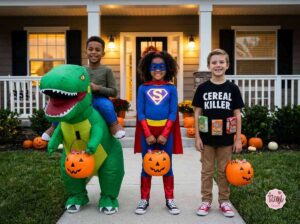
Today, Halloween costumes range from superheroes and pop princesses to funny puns and inflatable dinosaurs. But dressing up was originally a matter of spiritual survival.
The tradition traces directly back to the Celtic fears surrounding Samhain. Because the Celts believed that the boundary between the living and the dead was lifted on October 31st, they assumed that ghosts would be walking among them.
If a Celt had to leave their home after dark on Samhain, they were terrified of being recognized by a vengeful spirit whom they might have wronged in life. To avoid detection, people began wearing masks and disguises made from animal heads and skins when they left their homes after sundown. The logic was simple: if you looked like a ghoul, the real ghouls would mistake you for one of their own and leave you alone.
Furthermore, people would leave bowls of food and drink outside their doors to appease the wandering spirits and prevent them from attempting to enter the house.
The American Evolution of Costumes
The tradition of dressing up migrated to America with European immigrants, but it wasn’t until the 1920s and 1930s that costume-wearing became a mainstream, commercial enterprise in the United States.
Early American Halloween costumes were largely handmade and aimed squarely at being frightening—ghosts, witches, skeletons, and devils. However, as the 20th century progressed, companies like Ben Cooper, Inc. and Collegeville Flag and Manufacturing Company realized they could license pop culture characters. By the 1950s, kids were dressing up as Mickey Mouse, Superman, and Frankenstein’s monster, shifting the holiday’s aesthetic from genuinely terrifying to imaginative and consumer-driven.
The Surprising History of Trick-or-Treating
Of all the Halloween traditions, trick-or-treating might have the most complex and fascinating evolution. Going door-to-door begging for candy is a distinctly modern, North American invention, but its DNA consists of three historical practices: Souling, Guising, and Belsnickeling.
1. “Souling” in the Middle Ages
During the Middle Ages in Britain, impoverished citizens began a practice known as “souling” on Hallowmas (November 1st). The poor would visit the homes of the wealthy and offer to pray for the souls of the homeowners’ deceased relatives, who were believed to be trapped in Purgatory.
In exchange for these prayers, the wealthy families would give the beggars pastries called “soul cakes”—small, round cakes spiced with nutmeg and cinnamon, often marked with a cross on top. The church actively encouraged this practice as a pious alternative to the pagan tradition of leaving out food and wine for roaming spirits. Eventually, souling was taken up by children who would visit their neighbors to ask for ale, food, and money.
2. “Guising” in Scotland and Ireland
In Scotland and Ireland, souling evolved into a practice known as “guising.” Rather than pledging to pray for the dead, young people would dress up in costumes (disguises) and accept offerings from various households.
However, they didn’t just knock and hold out a bag; they had to earn their treats. The youths would perform a “trick”—such as reciting a poem, singing a song, telling a joke, or performing a small magic trick—in exchange for fruit, nuts, or coins.
3. “Belsnickeling” in America
A lesser-known influence on modern trick-or-treating comes from German-American communities, who practiced a Christmas tradition called Belsnickeling. Children would dress up in costumes and masks and go to their neighbors’ homes to see if the adults could guess their identities. If no one could identify them, they were rewarded with food or treats.
The Chaotic American Transition: When the “Trick” was Real
As Irish and Scottish immigrants flooded into the United States in the mid-19th century due to the potato famine, they brought their Halloween traditions with them. But by the late 19th and early 20th centuries, Halloween in America had evolved into a night of rampant pranks, vandalism, and mayhem.
For decades, the “trick” in trick-or-treat was a genuine threat. Young men and boys would use the anonymity of the dark and the excuse of the holiday to wreak havoc on their communities. Common pranks included:
-
Unlatching gates and letting livestock run loose.
-
Tipping over outhouses (often while people were inside).
-
Removing front gates from fences.
-
Egging homes and shattering windows.
-
Vandalizing public property.
During the Great Depression, this mischief escalated into costly vandalism and even violence. City councils and civic organizations across the United States realized they had a serious problem on their hands.
The Invention of Community Trick-or-Treating
To combat the destruction, towns and neighborhoods decided they needed to “buy off” the youth. In the 1930s, community leaders, schools, and parents began organizing structured, neighborhood-wide events to keep kids out of trouble.
They revived the old traditions of guising and souling, encouraging children to go door-to-door in their neighborhoods. Homeowners were encouraged to offer treats—nuts, popcorn balls, fruit, and homemade baked goods—to appease the children and prevent vandalism. The phrase “trick-or-treat” effectively functioned as a mild extortion tactic: “Give us a treat, or we will play a trick on your property.”
The practice was briefly halted during World War II due to sugar rationing, but with the post-war economic boom of the 1950s, trick-or-treating exploded. The suburbs were expanding, the Baby Boom resulted in millions of children roaming safe, well-lit neighborhoods, and the candy industry saw a massive financial opportunity.
Candy companies began heavily marketing small, individually wrapped sweets as the perfect, affordable item for homeowners to hand out. By the 1970s, mass-produced candy had entirely replaced homemade treats and fruits, driven largely by parental fears about food safety and the sheer convenience of bagged chocolate.
Halloween Today: A Tapestry of History
When you step back and look at the modern celebration of Halloween, it is incredible to see how ancient fears and medieval traditions have survived, mutated, and thrived in the 21st century.
-
When you carve a pumpkin, you are participating in a 19th-century Irish adaptation of a folklore warning about a man who tricked the Devil.
-
When you put on a costume, you are echoing the survival tactics of ancient Celts trying to hide from wandering spirits during Samhain.
-
And when you hand out candy to trick-or-treaters, you are partaking in a hybridized ritual of medieval soul cakes, Scottish guising, and a 1930s American neighborhood defense strategy against teenage vandalism.
Halloween is much more than a commercial cash grab; it is a living history lesson. It is a holiday that honors humanity’s age-old need to confront the darkness, laugh in the face of our fears, and find warmth and community as the cold winter approaches.
So, this October 31st, as you light your Jack-o’-lantern and listen for the doorbell to ring, take a moment to appreciate the thousands of years of human history that brought this bizarre, magical, and spooky holiday to your front porch. Happy Halloween!
